Brand Identity in Web Design: How to Build a Website That Looks and Feels Like You
Introduction
Scroll through enough websites and you start to see it. The same stock photos. The same button shapes. The same headlines structured the same way. Different business names, different industries, the same website.
This is what happens when brand identity is treated as optional in web design.
A website with no brand identity is not neutral. It is invisible. There is nothing for the user to remember. Nothing that communicates why this business is different, who built it, or why it deserves trust over the five other options in the same search result.
I have worked with Nigerian businesses, UK law firms, e-commerce brands in Europe, and the pattern is consistent across all of them. The businesses that stand out online are not always the biggest or the most established. They are the ones whose website communicates a clear, specific identity. You know who they are. You understand what they stand for. You feel something when you interact with their brand.
That feeling is built through design decisions. Color, typography, imagery, layout, tone, spacing, interaction patterns. Every one of these is a brand decision, not just a visual one.
This guide covers what brand identity means in web design, how to build it systematically, and how to express it consistently across every touchpoint of a website.
What Brand Identity Means in the Context of Web Design
Brand identity is the collection of visual and verbal elements that make a business recognisable and distinct.
In web design, brand identity manifests through everything the user can see and read:
The color palette and how it is applied. The typefaces chosen and how they are used. The photography style, whether it uses real team photos or stock images, the level of brightness and contrast, whether images feel editorial or casual. The illustration or icon style if present. The amount of white space and what that communicates about the brand's personality. The shape language of UI elements, whether buttons have rounded corners or sharp ones, whether cards have borders or float with shadows. The tone of every word written, the headlines, the CTAs, the error messages, the microcopy.
None of these are neutral choices. Each one communicates something. The question is whether that communication is intentional or accidental.
Most websites communicate accidentally. A theme was chosen because the client liked it. Stock photos were used because they were fast. The copy was written generically because the writer did not know enough about the brand to write specifically.
The result is a site that could belong to anyone and therefore belongs to no one.
Building a Brand Identity System for Your Website
A brand identity system is a set of documented rules for how your brand looks and sounds. It removes guesswork and ensures consistency across every designer, developer, or content writer who touches your website.
Color System
Your color system defines every color in your brand palette and the specific role each color plays.
A practical website color system has four layers:
Primary brand color: Used for CTAs, active states, key highlight elements. This is your most distinctive color. It should appear sparingly enough to retain its visual weight.
Secondary brand color: Used for accent elements, icon fills, visual interest. Supports the primary without competing with it.
Neutral palette: Background colors, surface colors, border colors. These form the foundation of every page. Light neutrals for backgrounds. Mid-range for surfaces and cards. Dark for high-contrast areas.
Semantic colors: Red for error states, green for success, yellow or amber for warnings, blue for informational states. These have universal meaning in interface design and should not be repurposed for decoration.
Each color should have a defined hex value and a named role. Not "our blue" but "interactive primary." Not "that dark background" but "surface dark."
Document your colors in a design system file. Every designer working on your site references the same values. Every developer uses the same CSS variables.
:root {
  --color-primary: #5A4FCF;
  --color-secondary: #00FFEB;
  --color-background: #1B1B2F;
  --color-surface: #252540;
  --color-text-primary: #F0F0FF;
  --color-text-secondary: #9898B8;
  --color-border: #3A3A58;
  --color-error: #FF4D6D;
  --color-success: #22C55E;
}
Using CSS custom properties for your color system means a brand color update requires changing one value and it propagates everywhere. It also makes your codebase readable: a developer seeing var(--color-primary) understands immediately that this element uses the primary brand color.
Typography System
Your typography system defines your typeface choices, your type scale, and the rules for applying each.
For most brands, two typefaces are enough. One for display and heading text. One for body and UI text. Pairing a distinctive heading font with a highly readable body font is the most common and most effective approach.
Define your full type scale as documented in the typography guide. Assign semantic names to each level: display, heading-1 through heading-4, body-large, body, body-small, caption, label. Document the font family, size, weight, line height, and letter spacing for each level on both desktop and mobile.
Typography reinforces brand personality. A luxury e-commerce brand uses an elegant serif for headings and a clean sans-serif for body. A tech startup uses a geometric sans for both, varying only weight and size. A traditional law firm might use a transitional serif throughout. A creative agency might choose an expressive display typeface for headings paired with a minimal sans for body.
The type pairing is a brand decision. Make it deliberately.
Visual Language: Photography, Illustration, and Iconography
The visual style of your imagery communicates as much as your color and type choices.
Photography style: Real photography of your team, your workspace, your process is almost always more effective than stock photography. It communicates that you are a real business with real people. If stock photography is unavoidable, choose a consistent style: bright and airy, dark and editorial, candid rather than posed, specific and detailed rather than generic. Never mix dark moody photography with bright cheerful photography in the same site.
Illustration: Some brands use custom illustration to express their personality in ways photography cannot. Illustration allows full control of color, shape, and style. It can be more distinctive than photography. The risk is inconsistency: illustrations drawn at different times by different hands look assembled rather than designed. If you use illustration, define a clear style guide.
Iconography: Icon sets communicate through consistency. A brand using line icons in one section and filled icons in another looks unresolved. Choose one style, regular weight or bold, line or filled, rounded or sharp, and apply it throughout.
Photography and illustration are the most underinvested parts of most website builds. Clients and developers focus on layout, color, and type, then drop in whatever images are available. The result is a site that is well-designed in structure but visually inconsistent in content.
Tone of Voice: The Verbal Identity of Your Brand
Your visual identity is only half of your brand identity on a website. The other half is verbal.
Tone of voice is how your brand speaks. Formal or informal. Authoritative or collaborative. Direct or discursive. Technical or accessible. Every word written for your website is a tone of voice decision.
Most websites have no defined tone of voice. The homepage was written by the business owner. The service pages were written by a different agency. The blog was handled by someone else. The result is a site that sounds like different people speaking at different times, which is exactly what it is.
A defined tone of voice covers:
Personality words: Three to five adjectives that describe your brand's voice. Confident, direct, and warm. Technical, precise, and accessible. Creative, energetic, and direct. These words guide every word written for the brand.
What we are and are not: "We are direct. We are not blunt. We are confident. We are not arrogant. We are technical. We are not jargon-heavy." These pairs clarify the fine line between the brand's intended voice and its common misapplication.
CTA language: Your CTAs should sound like your brand. A casual, energetic brand says "Let's Work Together." A formal professional services brand says "Schedule a Consultation." A direct, no-nonsense brand says "Get Started."
Error and empty state messages: Often overlooked, these are brand touchpoints. An error message that says "Oops! Something went wrong. Let's try that again." feels different from "Error 500: Internal Server Error." Both convey the same information. Only one sounds human.
Brand Identity Across the Full Website
Homepage
The homepage is the strongest expression of brand identity. The hero section must immediately communicate the brand's personality through its visual choices and copy tone, before the user reads a single word of body text.
A dark, full-bleed background with bold display typography communicates authority and confidence. A bright, airy hero with soft illustration communicates approachability and creativity. Neither is better. Both are intentional.
The visual treatment of the homepage should set the expectation for every other page on the site. If the homepage is refined and minimal, interior pages that are busy or visually noisy feel like they belong to a different site.
Service and Product Pages
Brand identity on service pages is expressed primarily through copy tone and visual consistency. The layout should follow the same spacing system, type scale, and color system as the rest of the site.
Photography or imagery on service pages should match the style established on the homepage. If the homepage uses real team photography, service pages should also use real photography, not stock.
Section treatments, the visual patterns used to separate content areas, background colors, dividers, card styles, should follow the brand's established design language. A brand using dark cards with subtle borders should not suddenly switch to light cards with heavy shadows on an interior page.
Blog and Long-Form Content
The blog is where tone of voice is most visible. The writing style, the reading level, the degree of formality, all of these should be consistent with the brand's defined voice.
Visually, blog posts should maintain the type scale and color system established across the site. Author photos, if used, should be consistent in style. Post header images should follow the brand's photography style.
The blog is often where brand consistency breaks down first because it is updated frequently, sometimes by multiple contributors. This is where a documented brand style guide is most valuable.
Footer
The footer is a brand touchpoint that is often treated as a technical necessity rather than a design element. A well-designed footer reinforces the brand through its visual treatment and provides a definitive final impression.
The footer color choice is a brand decision. Many brands use their darkest background color in the footer, creating a visual anchor that grounds the page. Others maintain the same background as the body. Both can work; what should not happen is a footer that looks visually disconnected from the rest of the site.
Logo treatment in the footer should match the header, in terms of version used (full logo, icon only, or wordmark) and color variant (primary, white, or monochrome version depending on background).
The Competitive Advantage of Strong Brand Identity
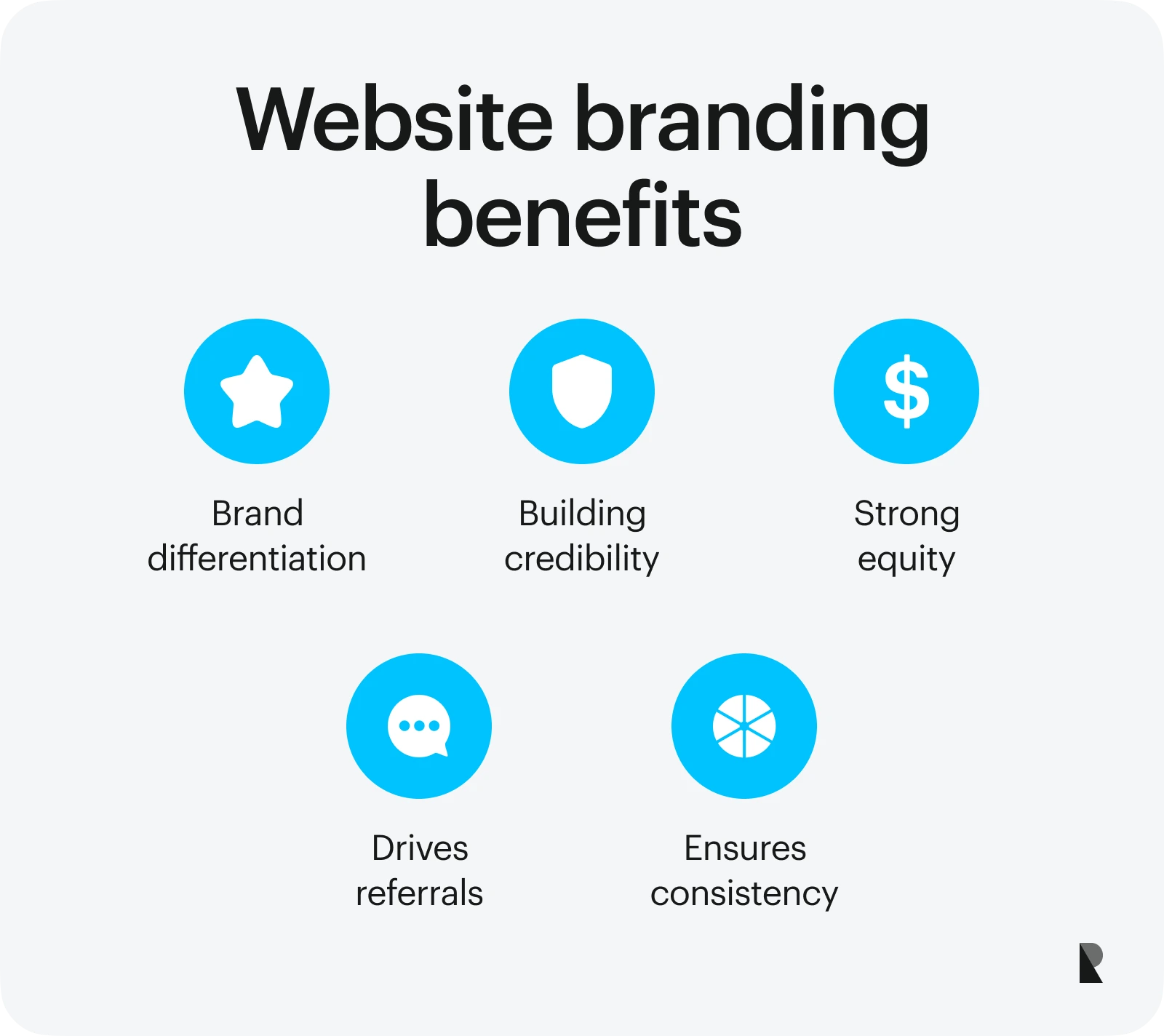
Brand identity is not a luxury for large businesses. For small businesses and independent agencies, it is a competitive tool.
In a market where every competitor has a WordPress site with the same theme, a website with a clear, distinctive brand identity stands apart. It communicates professionalism. It builds trust before the user reads your service description. It makes you memorable after they leave and consider their options.
In Nigeria, where digital services are still building market trust, brand consistency signals legitimacy. A business whose website looks polished and considered tells the market that the business itself is polished and considered. Conversely, a site that looks like it was assembled quickly from free templates communicates that the business may not be worth the investment.
For international clients, a strong brand identity communicates that you operate at a level they are familiar with. UK and European clients buying services from Nigerian agencies want to see that the agency operates to the same standard as the international market. The website is the first proof of that.
Common Brand Identity Mistakes in Web Design
Using brand colors inconsistently. The hero uses one shade of blue. A section background uses a slightly different shade. The CTA uses a third shade. These are not three shades of the brand color. They are three errors. Use CSS variables and stick to them.
Too many brand colors. Some brands arrive with a "palette" of fifteen colors. On a website, this becomes noise. If everything is colorful, nothing stands out. Reduce to a primary, a secondary, and a neutral set.
Stock photography that contradicts the brand. A local Nigerian services business using photos of American office environments. A premium brand using generic stock images with watermarks still visible. A technology company using photos of people obviously not in tech environments.
Copy that sounds like it was written by a different brand. The homepage has personality. The service pages are formal and dry. The blog is chatty and inconsistent. The site sounds like three different businesses.
Logos that do not scale. A detailed logo that looks sharp at 300px wide becomes illegible as a favicon at 32px. Every brand needs a full logo version, a simplified version, and an icon or monogram that works at small sizes.
Typography mismatches between Canva graphics and the website. A brand creates their social media graphics in Canva using a font that is different from their website typography. The brand appears inconsistent across touchpoints.
Conclusion
Brand identity in web design is the accumulation of hundreds of small decisions made consistently.
No single element builds a brand. But every element either reinforces or undermines one. The color choice reinforces or contradicts. The font communicates or confuses. The photography style builds or breaks trust. The copy voice connects or alienates.
The investment in a clear brand identity system, documented and applied consistently, is the investment that makes every other design decision easier. When you know what your brand is, every question about what a page should look like has an answer.
Build your system. Document it. Apply it everywhere. Every time.
Want a Website That Actually Looks Like Your Brand?
JetherVerse builds brand identities and websites that work together from the start. We work with businesses in Nigeria, the UK, and across Africa to create digital presences that stand out and convert.
- Email: info@jetherverse.net.ng
- Phone: +234 915 983 1034
- Website: www.jetherverse.net.ng